






































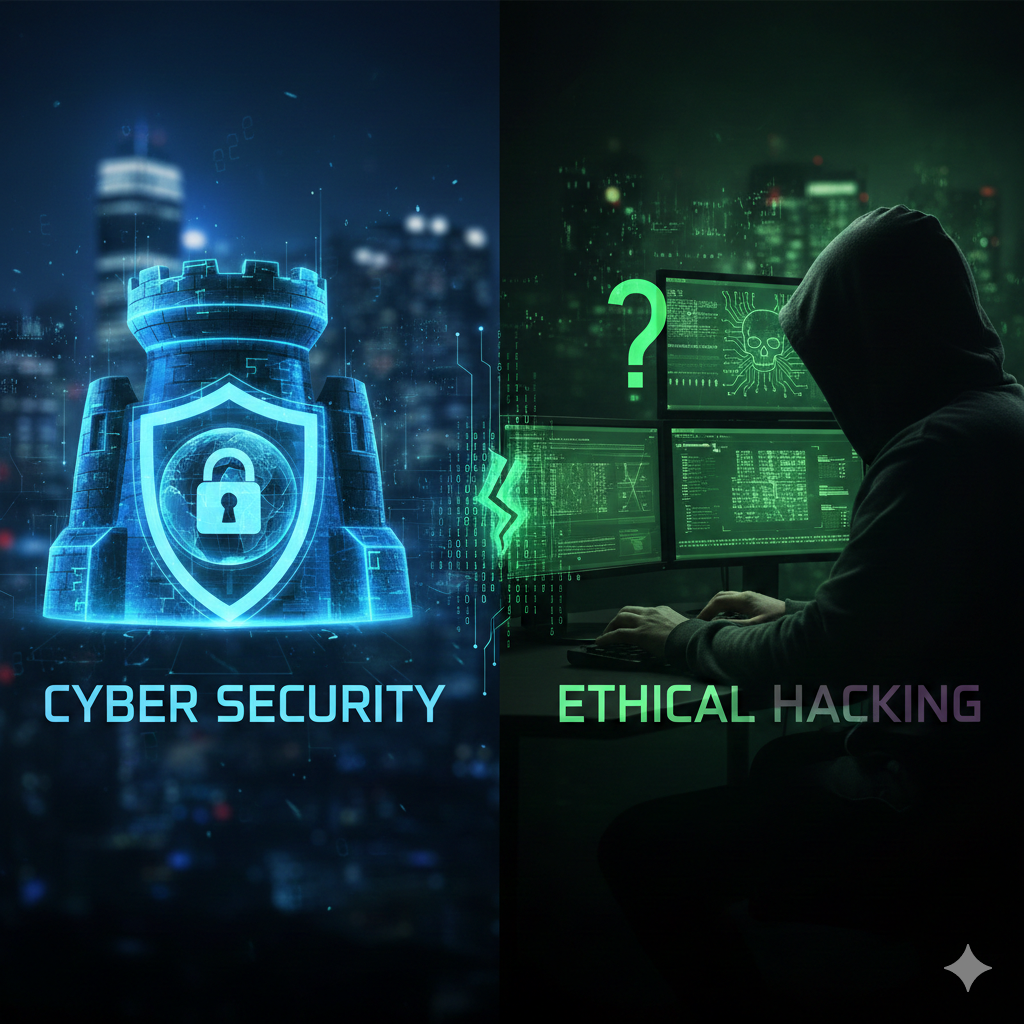

Cyber Security & Ethical Hacking

4.9/5 Based on 12,784 reviews

Join the program and learn under the guidance of a Cyber Security & Ethical Hacking specialist.

Trainer Image
Expert Training Specialist

Cyber Security & Ethical Hacking Course

(1556 reviews)

Cyber Security & Ethical Hacking professionals are in high demand as organizations need experts to protect systems, networks, and data from cyber threats. This course helps you understand cyber attacks, vulnerabilities, and defense techniques. You’ll learn how hackers think, how to secure systems, and how to ethically test networks and applications using real-world tools and scenarios.

Course Objectives

  • Cyber Security Fundamentals: Understand the basics of cyber security, types of cyber threats, malware, phishing, ransomware, and security concepts.
  • Ethical Hacking Concepts: Learn ethical hacking methodologies, hacking phases, footprinting, reconnaissance, scanning, and enumeration techniques.
  • Network & System Security: Gain knowledge of network security, firewalls, IDS/IPS, ports, protocols, and securing Windows & Linux systems.
  • Web Application Security: Learn to identify and prevent web vulnerabilities like SQL Injection, XSS, CSRF, file inclusion, and authentication attacks.
  • Ethical Hacking Tools: Work with popular tools such as Kali Linux, Nmap, Metasploit, Burp Suite, Wireshark, and vulnerability scanners.
  • Real-Time Security Projects: Perform practical labs like penetration testing, vulnerability assessment, system hardening, and security audits.
image not found
  • Placement
    Records
  • Category
    Cyber sec & ethical Hacking
  • Language
    English
  • Access
    3 Months
  • Certificate
    Yes

Who Needs to Go

  • Students who want to start a career in Cyber Security or Ethical Hacking.
  • Freshers looking to enter the IT industry with security skills.
  • Beginners who want to learn ethical hacking from scratch.
  • Network engineers who want to add cybersecurity expertise.
  • Professionals aiming to upskill in information security and cyber defense.
  • IT professionals preparing for security-related job roles.
  • Freelancers who want to offer cybersecurity services.
  • Self-taught learners seeking structured ethical hacking training.
  • Working professionals planning to switch to cybersecurity roles.
  • Tech enthusiasts interested in system, network, and web security.

Get In Touch!

We are happy to help you 24/7

XFcBV3


Why Choose NS3EDU?

  • Industry-focused Cyber Security & Ethical Hacking training.
  • Hands-on lab practice instead of only theory.
  • Training by experienced security professionals.
  • Real-world attack & defense scenario-based learning.
  • Step-by-step guidance from basics to advanced level.
  • Live tools practice (Kali Linux, Nmap, Wireshark, etc.).
  • Resume building & interview preparation support.
  • Real-time security projects for portfolio.
  • Career guidance for Cyber Security job roles.
  • Certification after successful course completion.
Ns3Edu Certificate


Modules

Step-by-step modules to master Cyber Security & Ethical Hacking

01
Cyber Security Basics

Introduction to cybersecurity, types of hackers, threats, vulnerabilities, and security concepts.

02
Networking Fundamentals

TCP/IP model, IP addressing, ports, protocols, and how networks communicate.

03
Linux for Hackers

Linux commands, file system, permissions, and using Kali Linux.

04
Footprinting & Reconnaissance

Information gathering techniques and tools used before an attack.

05
Scanning & Enumeration

Using tools like Nmap and Wireshark to scan networks and find open ports.

06
System Hacking Concepts

Password attacks, privilege escalation concepts, and system vulnerabilities.

07
Web Application Security

Understanding common web vulnerabilities and security flaws.

08
Ethical Hacking Tools

Working with Metasploit, Burp Suite, and other testing tools.

09
Wireless Network Security

Wi-Fi security, encryption types, and wireless attack concepts.

10
Cyber Defense & Protection

Firewalls, IDS/IPS, antivirus, and security best practices.

11
Security Policies & Risk Management

Understanding risk, compliance, and security policies in organizations.

12
Final Cyber Security Project

Perform a complete security assessment and vulnerability analysis in a lab setup.


Optional Add-ons

  • Free access to our Cyber Security practice lab for hands-on exercises.
  • Bonus penetration testing case studies with reports.
  • Real-world vulnerability assessment samples and security tools practice.

Placement Support

  • Project review to ensure your security assessments meet industry standards.
  • Resume & LinkedIn optimization for Cyber Security and Ethical Hacking roles.
  • Mock interviews covering networking, security concepts, and ethical hacking tools.
  • Guidance on real-world security workflows and best practices.

Career Paths & Job Roles

  • Cyber Security Analyst: Monitor, detect, and prevent cyber threats in organizations.
  • Ethical Hacker (Penetration Tester): Test systems and networks for vulnerabilities.
  • Network Security Engineer: Secure networks, firewalls, and communication systems.
  • Security Consultant: Advise companies on security policies and risk management.
  • Freelance Security Specialist: Provide security testing and vulnerability assessment services.


Eligibility & Requirements

No strict academic requirement. Basic computer knowledge and interest in networking is enough. Even beginners can start — we teach cybersecurity and ethical hacking step-by-step from fundamentals.

Learning Methodology

Our approach follows: Concept → Lab Practice → Real-Time Scenario. You learn security concepts, apply them through hands-on tools, and finally perform ethical hacking in simulated environments.

Portfolio Deliverables

By the end, you will perform vulnerability assessments, penetration testing reports, and security audits ready to showcase to companies.


Frequently Asked Questions

What fundamentals are covered in the Cyber Security course?

This course builds a strong foundation in cybersecurity and ethical hacking.

  • Networking & Security Basics
  • Linux Fundamentals
  • Footprinting & Scanning
  • Common Cyber Attacks
  • Ethical Hacking Tools
  • Web Application Security
  • Network Defense
  • Security Best Practices
What career options are available after completing this training?

After completing the course, you can apply for multiple cybersecurity roles.

  • Cyber Security Analyst
  • Ethical Hacker
  • Penetration Tester
  • Network Security Engineer
  • Security Consultant
  • Security Operations Analyst
Do I need prior coding knowledge?
No. Beginners can start from scratch. We cover networking and security basics before advanced topics.
Is this course practical or theoretical?
This is a hands-on course with real lab environments and security testing practice.
How long does it take to learn Cyber Security?
On average, it takes 4–6 months, depending on practice and lab work.

Start Your Learning Journey

★ 4.9
IT Networking
  • Routing & Switching
  • Network Security
  • Hardware Management
Download Brochure
★ 5.0
Cloud Engineering
  • AWS & Azure Cloud
  • Serverless Architecture
  • Deployment Strategies
Download Brochure
★ 4.8
Cyber Security
  • Ethical Hacking
  • Threat Analysis
  • Data Protection
Download Brochure
★ 4.7
Digital Marketing
  • Search Engine Opt.
  • Social Media Ads
  • Brand Management
Download Brochure
★ 5.0
MERN Stack Dev
  • ReactJS & Node.js
  • Database Scaling
  • API Development
Download Brochure
★ 4.9
Data Science
  • Python & AI Models
  • Data Visualization
  • Business Insights
Download Brochure
★ 5.0
UI/UX Designing
  • Figma & Adobe XD
  • Prototyping
  • User Research
Download Brochure